Date and Time: Wednesday October 26: 2 PM Amsterdam, 2 PM South Africa, 9 AM Brasilia, 1 PM UK, 5.30 PM New Delhi, 8 AM New York
Registration: https://din.today/registration-webinar-decolonizing-the-mind-october-26-2023/
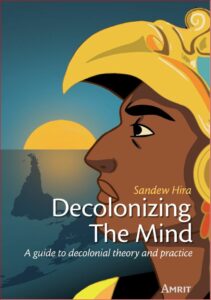 Speaker: Sandew Hira, penname of Dew Baboeram, is secretary of the Decolonial International Network Foundation (DIN). He studied economics at the Erasmus University Rotterdam in Holland. He has written 16 books on different topics among them colonial history. His forthcoming book is titled Decolonizing The Mind: A guide to decolonial theory and practice (Amrit Publisher, January 15 2023). His CV is here: https://iisr.nl/wp-content/uploads/2020/10/CV-Sandew-Hira-20200921.pdf.
Moderator: Munyaradzi Mushonga, Global Academic Director of DIN.
Topic
On January 15, 2023 Amrit Publishers will publish a special book by Sandew Hira titled “Decolonizing The Mind – A guide to decolonial theory and practice”. This book is special because of different reasons.
First, across the globe there is a rise of a movement inside and outside the academia that labels their narrative as “decolonial”. Academics and activists have made great contributions to decolonial theory and practice that have been incorporated in this book.
Hira’s book is an attempt to bring these contributions together in a comprehensive, coherent and integral theoretical framework. Western Enlightenment has produced two such frameworks: Liberalism and Marxism. A comprehensive, coherent and integral theoretical framework has the following characteristics:
- It is comprehensive because it has produced concepts of how to look at the most important dimensions of a society: a world view, economics, social relations including relations with nature, politics and culture. There are other important aspects of a society, but these dimensions are essential to make a framework comprehensive.
- It is coherent because its concepts don’t contradict each other. They are consistent and logical.
- It is integral because the concepts of the different dimensions are not just lumped together but are related to each other from a basic concept. In Liberalism it is “individual freedom” and in Marxism “class struggle”. In decolonial theory it is mental slavery and decolonizing the mind.
Second, the book is a systematic guide to decolonize the mind. Decolonizing the mind consists of three dimensions:
- The critique of the Western colonization of the mind and thus Eurocentric knowledge production.
- The development of an alternative comprehensive, coherent and integral knowledge production.
- The translation of this new knowledge in viable policies to built a new pluriversal world civilization.
Third, the book appeals both to academics who can use the book as teaching material, but also to activists who are figuring out to build social movements that go beyond the dichotomy of Liberalism and Marxism.
Fourth, the book is part of a greater vision of how produce and transfer decolonial knowledge. It is not only about producing and distributing a book. It is also about linking theoretical concepts with art. An example is the musical documentary produced by Pravini: The Uprising.
And most importantly, the book is the basis for producing decolonial knowledge in the for of sources, summer school, workshops etc.
Book specifications
- Publication date: January 15, 2023
- Price: € 35,00
- ISBN: 978-90-74897-47-1
- Format: A5 (148×210 mm)
- Pages: 600
Content
Preface
- Introduction
- The background of the rise of the decolonial movement and theory
- Two Eurocentric philosophies of liberation
- Mental slavery and the colonization of the mind
- Epistemology: The manipulation of the mind through knowledge production
- A decolonial theory of racism
- Decolonizing mathematics and natural sciences
- Decolonizing world history
- Decolonizing economic theory
- Decolonizing social theory
- Decolonizing cultural theory
- Decolonizing political theory
- Imagining a new world civilization

 On October 12 Aralez in the Netherlands organize a day full of activities including; a solidarity march, Mapu commemoration and solidarity ceremony, a 1492 people’s tribunal, cultural performances and panels. Together we commemorate the day Columbus invaded Abya Yala (the American continent) in 1492. A date that marks the symbolic beginning of European colonialism. A process that has institutionalised genocide and ecocide worldwide. As a result, the right to self-determination, identity and culture of Indigenous People’s is still under pressure. Indigenous land defenders are displaced and killed; rivers and environment polluted; and land expropriated for the profit of large multinationals. The result is the current climate crisis. Therefore, it is time for reparatory justice and decolonisation! This festival offers a platform to critical perspectives on the climate crisis, healing, cultural values, and solidarity.
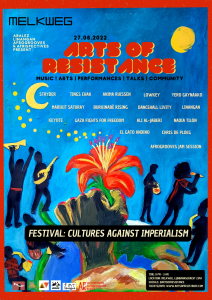 Colonialism is not history. To this day, vast amounts of resources and labour-power are transferred each year from the Global South to the Global North. Governments are overthrown, workers exploited and ecosystems destroyed by Western multinational corporations. Throughout history there has been a rich tradition of anti-imperialist resistance in cultural and art movements.” From mass cultural organizations in Indonesia such as Lekra, to revolutionary artists working on Global South unity in Cuba. This festival will honour anti-imperialist resistance art, then and now. Ranging from conscious hip-hop to the art of drawing, from film and panelists to dance and afrobeat, we have a line-up full of organizers and artists that will bring anti-imperialist resistance alive in Amsterdam.
 Almost 30 years after the fall of Apartheid in South Africa the country has still to find its way in improving the living standards of the masses and transforming the old society in a new one. The Rhodes Must Fall movement and other movements which came along with it put an enormous pressure on the Government of South Africa to do something of decolonization. The Department of Higher Education and Training (DHET) has demanded from each and every university that they present their policy on how to deal with decolonizing the university. A university is also judged on their relevance for society. They have to connect with communities outside the academia. In South Africa – and the black communities in general – the focus on decolonial theory is on Decolonizing The Mind. This goes back to the traditions of Marcus Garvey. It is encouraging to note that Government of South Africa has also taken the decolonization trajectory to schools by demanding the “the teaching and promotion of African languages, South African and African history and national symbols to all learners up to Grade 12”.